
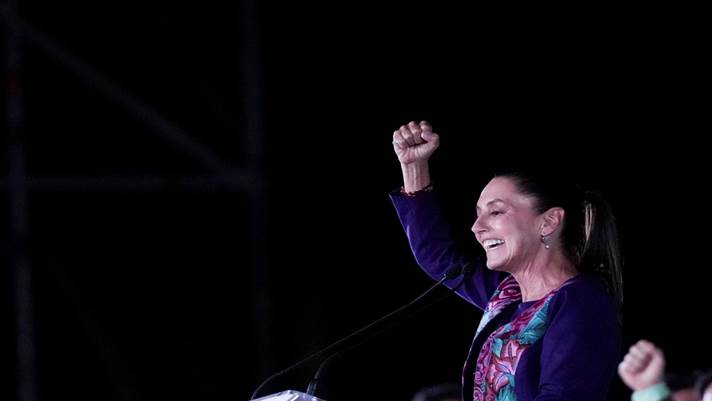
Claudia Sheinbaum Pardo, often referred to simply as Claudia Sheinbaum, has made history as the first female president of Mexico and the country’s first Jewish head of state. A scientist-turned-politician, she represents a unique blend of academic rigor and political pragmatism. Despite holding the most powerful office in Mexico, Sheinbaum’s net worth is estimated at just $200,000, a modest sum compared to global leaders.
Her financial disclosures paint a picture of a leader grounded in academic and public service traditions, rather than one driven by wealth accumulation. In fact, her assets are modest: a small apartment, an economy car, and a handful of bank accounts. This makes her one of the least wealthy world leaders, reinforcing her reputation as a politician focused on social programs, sustainability, and equity.
Salary and Official Earnings
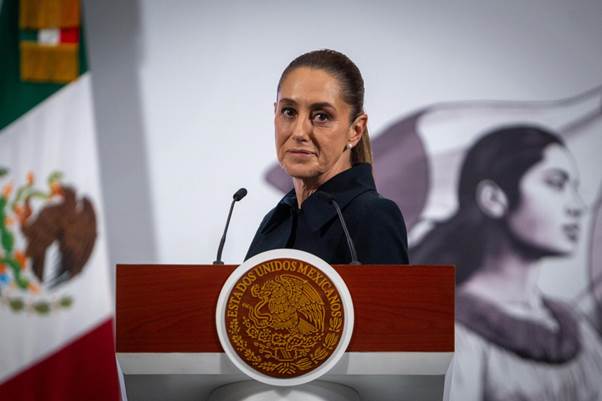
As President of Mexico, Claudia Sheinbaum earns a monthly net salary of 134,290 MXN, which is roughly $7,800 USD per month. On an annual basis, this equates to about 1.61 million MXN (or $93,000 USD).
Her salary, while high by local standards, is significantly lower than what many global heads of state earn. For comparison:
- The U.S. President earns $400,000 annually.
- France’s President makes around €180,000 annually.
- Mexico’s salary caps, instituted under former President Andrés Manuel López Obrador, ensure public servants—including the president—earn comparatively modest wages.
This aligns with Sheinbaum’s austerity-driven political philosophy, rooted in prioritizing public funds for welfare programs and infrastructure over personal enrichment.
Financial Disclosure
In her most recent disclosure filed on May 30, 2025, Sheinbaum declared assets and holdings consistent with a middle-class professional lifestyle:
- Apartment: An 88-square-meter residence purchased in 1999 for 275,000 MXN (around $15,000 USD at the time).
- Vehicle: A 2013 Chevrolet Aveo, valued at about 164,900 MXN ($9,000 USD).
- Bank Accounts: Three accounts with BBVA — a checking account, a savings/investment account, and a credit card with no reported debt.
- Business Holdings: An 8% ownership stake in two small manufacturing firms, though she reported no income or dividends from these shares.
This level of transparency, and the relatively modest value of her declared assets, has reinforced her reputation as a politician committed to public service over personal gain.
Early Life and Education
Born on June 24, 1962, in Mexico City, Claudia Sheinbaum grew up in a household deeply influenced by science and progressive values. Her mother, Annie Pardo, was a biologist and professor, while her father, Carlos Sheinbaum, worked as a chemical engineer.
Claudia is the second of three children, with an older brother, Julio, and a younger sister, Adriana. The family’s Jewish heritage connects back to European immigrants who sought refuge in Mexico during the 20th century.

Her educational journey was distinguished:
- She earned her bachelor’s, master’s, and doctoral degrees in science from the National Autonomous University of Mexico (UNAM).
- Her doctoral research focused on energy engineering and environmental sustainability.
- She conducted part of her thesis research at the Lawrence Berkeley National Laboratory in California, receiving her PhD in 1995.
This strong scientific foundation would later shape her policy focus on climate change, renewable energy, and sustainability.
Academic and Scientific Career
Before entering politics full-time, Sheinbaum established herself as a respected academic.
- She became a faculty member at UNAM’s Institute of Engineering, specializing in energy and climate research.
- She co-authored over 100 scholarly articles and two books on energy efficiency, emissions, and sustainable development.
- In 2007, she was part of the Intergovernmental Panel on Climate Change (IPCC) team that shared the Nobel Peace Prize with Al Gore for contributions to climate science.
Her scientific expertise continues to influence her leadership style, with an emphasis on data-driven policymaking and environmental sustainability.
Entry into Politics
Sheinbaum’s political career began while she was still a student. In 1989, she joined the Party of the Democratic Revolution (PRD), aligning with progressive and left-leaning causes.
Her first major government role came in 2000, when she was appointed Secretary of the Environment for the Federal District (Mexico City). During her six-year tenure, she:
- Helped introduce the Metrobús system, Mexico City’s rapid transit bus network.
- Promoted sustainable urban planning and cleaner transportation options.
This experience served as the foundation for her later leadership positions.

Mayor of Tlalpan (2015–2017)
In 2014, Sheinbaum joined the newly formed National Regeneration Movement (MORENA), founded by Andrés Manuel López Obrador (AMLO). She ran for mayor of Tlalpan, one of Mexico City’s largest boroughs, and won in 2015.
As mayor, she focused on:
- Improving public services like water distribution.
- Expanding social programs for families and children.
- Implementing anti-corruption measures at the local level.
Her governance style—firm, pragmatic, and people-oriented—earned her credibility as a rising political figure.
Head of Government of Mexico City (2018–2023)
In 2018, Sheinbaum was elected Head of Government of Mexico City, the equivalent of a state governor and the second-most powerful elected office in Mexico.
Key achievements during her tenure:
- Security & Public Safety: She introduced new policing models to reduce crime.
- Transportation: Expanded the public transit system and promoted green mobility.
- COVID-19 Response: Managed the pandemic with science-based measures.
- Metro Collapse Crisis: Faced political backlash in 2021 after a metro overpass collapse, but took responsibility and initiated reforms.
Her leadership, though tested, demonstrated resilience and a commitment to transparency.
President of Mexico (2024–Present)
In mid-2023, Sheinbaum resigned from her Mexico City role to run for president. Backed by the Juntos Hacemos Historia coalition, she launched her campaign in March 2024.
Her victory was historic:
- Defeated opponent Xóchitl Gálvez in a landslide.
- Won the highest number of votes ever recorded for a presidential candidate in Mexican history.
- Became Mexico’s first female president.
Presidential Priorities
As president, Sheinbaum has focused on:
- Codifying social programs into the Constitution.
- Expanding state control over the energy sector.
- Raising the minimum wage.
- Accelerating efforts to fight organized crime and drug violence.
- Investing in rail expansion and infrastructure projects.
Her presidency reflects a continuation of AMLO’s populist, welfare-driven agenda, but with a greater emphasis on climate action and social equality.

Honors and Recognition
Throughout her career, Sheinbaum has been honored for both her scientific contributions and political leadership:
- Jesus Silva Herzog Award (1995) – for economics research.
- UNAM Prize for Young Academics (2001).
- Nobel Peace Prize (2007) – shared with the IPCC team.
- Sustainability Medal (2024) – from the Nobel Sustainability Trust.
These accolades highlight her dual legacy as both a scientist and a stateswoman.
Personal Life
Claudia Sheinbaum married Carlos Ímaz Gispert in 1987. Ímaz was a co-founder of the PRD and a political figure in his own right. The couple had one daughter, Mariana, and Claudia also raised Ímaz’s son, Rodrigo. Their marriage ended in divorce in 2016.
In 2023, Sheinbaum remarried, tying the knot with Jesús María Tarriba Unger, a financial risk specialist at the Bank of Mexico, whom she originally met during her university days.

Legacy and Outlook
With a modest net worth of $200,000, Claudia Sheinbaum stands out in global politics as a leader not defined by wealth but by academic integrity, progressive ideals, and political resilience. She embodies the possibility of governing with modest personal means while commanding immense political power.
Her presidency represents a new chapter in Mexico’s history: a scientist-president, a woman breaking the highest glass ceiling, and a progressive leader balancing economic growth, social welfare, and sustainability.
For Mexico and the world, Sheinbaum’s legacy will likely be measured not by her personal fortune but by whether she succeeds in building a fairer, greener, and more equitable society.