

In the summer of 1997, audiences were captivated by the high-stakes drama of “Air Force One.” The film featured Harrison Ford at the peak of his box-office power, playing a president-turned-action-hero battling terrorists aboard his own aircraft. For his efforts, Ford commanded a staggering $22 million payday, a career-high sum that cemented his status as one of Hollywood’s most bankable stars. Moviegoers left theaters convinced they had just watched the most powerful person on screen. They were wrong.
The true titan of industry wasn’t the actor playing the leader of the free world; it was the young girl playing his daughter. While Harrison Ford’s net worth hovered around $50 million at the time, his 12-year-old co-star, Liesel Matthews, was already the beneficiary of a fortune that dwarfed his. The unassuming teenager was, in fact, Liesel Pritzker, an heir to one of America’s most formidable and private dynasties. On that film set, a fascinating paradox was at play: a global superstar was taking orders from a director for a multi-million dollar fee, while a soft-spoken middle-schooler, whose family’s wealth could have funded the entire production dozens of times over, simply followed her creative passion.
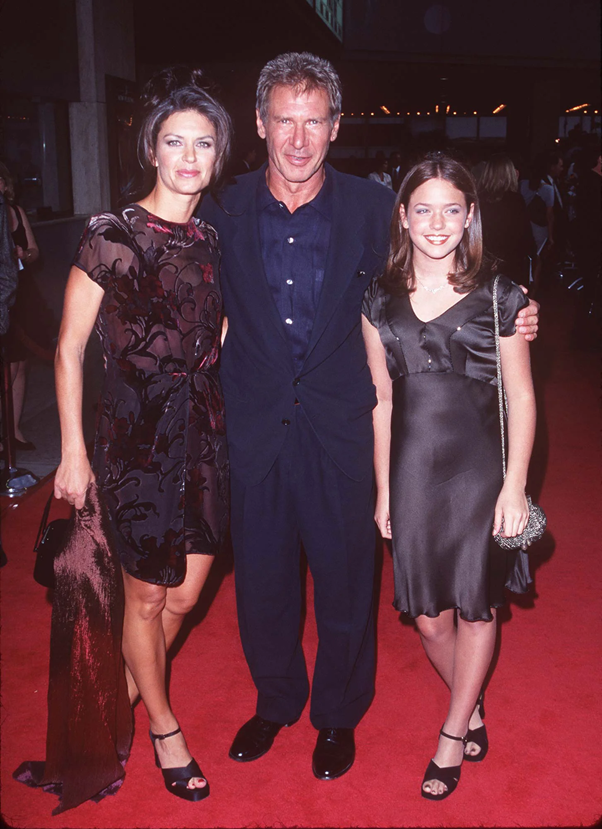
A Brief Foray into the Spotlight
Before she was navigating the corridors of a fictional Air Force One, Liesel Matthews was already a recognized talent. Born Liesel Anne Pritzker in Chicago, she borrowed her brother’s name for her stage moniker, a small attempt to carve out an identity separate from her famous family. Her breakout role came in 1995 in Alfonso Cuarón’s magical adaptation of “A Little Princess,” a performance that earned critical acclaim and a nomination for a Young Artist Award.
Her role in “Air Force One” as the president’s daughter seemed like a natural step for a rising young actor. Yet, after one final role in 2000, she vanished from Hollywood. The industry assumed she had simply retired from acting, as many child stars do. In reality, she was stepping away to confront a drama of a far different kind—one that would determine the fate of her future and her family’s billions.
The Unseen Empire: The Pritzker Dynasty
To understand the scale of Liesel’s wealth is to understand the Pritzker family itself—a name synonymous with American industrial royalty. Her grandfather, A.N. Pritzker, was a Chicago business magnate who built a sprawling empire from the ground up. The family’s holdings were vast, complex, and notoriously private, a web of trusts and partnerships controlling a significant portion of the American economy.

The most recognizable pillar of this empire is the global hospitality giant Hyatt Hotels, founded by her uncle, Jay Pritzker. But the family’s influence extended far beyond hotel lobbies. Through the Marmon Group, a colossal industrial conglomerate built by her father, Robert Pritzker, they held interests in everything from manufacturing and transportation to finance. They held major stakes in Braniff Airlines, Royal Caribbean cruise lines, and perhaps most tellingly, TransUnion, one of the nation’s three major credit bureaus. By the mid-1990s, the total family fortune was a labyrinthine entity estimated at $15 billion.
The Billion-Dollar Lawsuit: Heiress vs. Dynasty
While attending Columbia University in 2002, Liesel and her brother, Matthew, filed a lawsuit that would rip the veil off the Pritzker family’s private financial world. The suit alleged that their father and eleven cousins had systematically drained trusts that had been established for them as children, folding hundreds of millions of dollars of their inheritance back into the broader family coffers.
The legal battle was a sensational public spectacle, forcing one of America’s most secretive clans into the open. It was not merely a fight over money; it was a fight for acknowledgment and autonomy. After years of litigation, a historic settlement was reached in 2005. The family agreed to a monumental division of its assets. The result was immediate: ten new Pritzkers appeared on the Forbes 400 list of wealthiest Americans simultaneously. Liesel and her brother each received approximately $500 million in cash and assets, a sum that has since grown to an estimated net worth of $1.5 billion for Liesel today.
From Inheritance to Impact: Redefining a Legacy
Where many heirs to great fortunes might retreat into a life of luxury, Liesel Pritzker Simmons chose a path of profound purpose. Alongside her husband, Ian Simmons—himself an heir to the Montgomery Ward legacy—she co-founded the Blue Haven Initiative. This is not a traditional investment firm; it is a pioneering “impact investing” family office dedicated to deploying capital in ventures that generate both a financial return and a measurable, positive social or environmental benefit.
Through Blue Haven, Liesel has moved far beyond the world of Hollywood and high finance. She has become a quiet force for global change, investing in visionary entrepreneurs tackling some of the world’s most pressing problems. Her portfolio includes companies like EcoPost in Kenya, which tackles plastic pollution by transforming waste into durable building materials, and Karibu Homes, which develops affordable, sustainable housing. She also founded the Young Ambassadors for Opportunity (YAO), a philanthropic network supporting microfinance initiatives that empower women and entrepreneurs in the world’s most impoverished communities.

So, while Harrison Ford’s net worth has impressively grown to an estimated $300 million, his former on-screen daughter now operates on a different plane entirely. Liesel Pritzker Simmons’s story is a remarkable tale of two different kinds of power: one earned in the glare of the Hollywood spotlight, and the other inherited, then fiercely fought for, and ultimately redirected toward building a better world. She didn’t just win a fortune; she redefined what to do with it.